

Compliance
ISO 27001 Certification Timeline: How to Automate Evidence Collection with Screenshots
The ISO 27001 certification timeline takes 6 to 9 months, but manual evidence collection often causes delays right before the Stage 2 audit. This guide explains the exact schedule for ISMS documentation and Annex A controls, and how to automate screenshots to keep your audit on track.
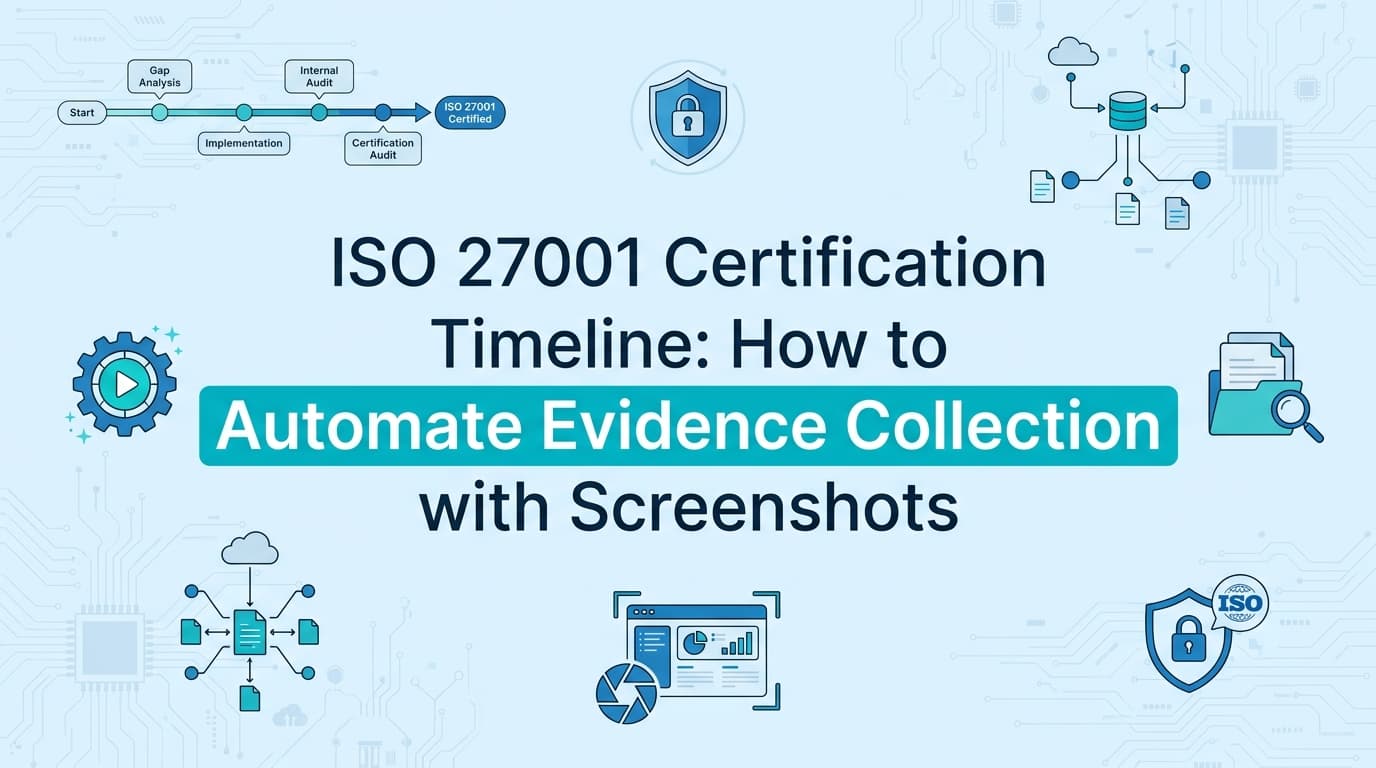
The ISO 27001 certification timeline usually spans six to nine months, split across ISMS design, Stage 1, and Stage 2 audits. Stage 2 is exactly where schedules tend to fall apart. Auditors expect concrete evidence for every applicable Annex A control listed in your Statement of Applicability. If your engineering team is manually gathering screenshots for access controls or change management workflows, you will likely delay the audit. Automation fixes this bottleneck. By using tools to capture screenshots automatically, you can continuously gather Annex A documentation in the background, ensuring your evidence collection stays ahead of the auditor's requests.
What Does the ISO 27001 Certification Timeline Actually Look Like?
The ISO 27001 certification timeline takes 6 to 9 months from project kickoff to the final Stage 2 audit report. It requires building the Information Security Management System (ISMS), performing a risk assessment, operating the controls for a minimum period, and passing two distinct external audit stages.
Most teams underestimate how much of this timeline is dedicated purely to waiting for systems to generate enough historical data. You cannot build an ISMS on Monday and audit it on Friday. Auditors need to see the machine running.
Here is the practical schedule most organizations follow:
Months 1-2: Scoping and ISMS Design You define the boundaries of your ISMS. This involves identifying which physical locations, business units, and technical systems fall under the scope of the certification. You also draft your core information security policies during this window.
Month 3: Risk Assessment and SoA You conduct a formal risk assessment. Based on the risks identified, you select the appropriate controls from Annex A to mitigate them. This results in your Statement of Applicability (SoA), which acts as the master checklist for your entire audit.
Months 4-6: Control Operation and Internal Audit ISO 27001 requires you to operate your ISMS for a period of time before the external auditor arrives, typically three months. During this window, you must perform a full internal audit and hold a management review meeting. This is when evidence collection actually begins.
Months 7-9: Stage 1 and Stage 2 Audits The external audit happens in two parts. Stage 1 is a documentation review to ensure your ISMS is designed correctly. Stage 2 is the main event where the auditor tests the operating effectiveness of your controls by inspecting your evidence.
When Do Auditors Require Annex A Evidence During the Timeline?
Auditors require entirely different types of evidence at different stages of the timeline. Stage 1 requires high-level ISMS documentation and policy evidence. Stage 2 requires granular operational evidence, including screenshots and system logs, proving that your Annex A controls function correctly in reality.
The biggest mistake teams make is treating Stage 1 and Stage 2 as the same exercise. If you show up to Stage 1 with hundreds of screenshots of your AWS configuration, the auditor will ignore them. If you show up to Stage 2 with just a stack of written policies, you will fail the audit.
| Audit Phase | Focus Area | Required Evidence Types | Examples |
|---|---|---|---|
| Stage 1 | Design and Documentation | Policies, procedures, risk registers, and framework artifacts. | Information Security Policy, Risk Assessment Report, Statement of Applicability (SoA), Internal Audit Report. |
| Stage 2 | Operating Effectiveness | Visual proof, system exports, logs, and historical records. | A.5.15 (Access Control) screenshots, A.8.9 (Configuration Management) deployment logs, documented incident response tickets. |
You need to schedule your collection efforts around these two distinct milestones. Stage 1 evidence is mostly generated by your compliance or security team writing documents. Stage 2 evidence requires pulling data from your actual infrastructure, HR systems, and engineering workflows.
What ISO 27001 Evidence Cannot Be Automated with Traditional GRC Tools?
Traditional GRC platforms connect to cloud APIs to monitor infrastructure, but they leave a massive gap in application-level Annex A controls. You still have to manually collect visual proof for internal admin panels, HR offboarding workflows, and custom SaaS configurations.
APIs are great for verifying cloud posture. A tool can query AWS and confirm that encryption is enabled, satisfying A.8.24 (Cryptography). But APIs cannot capture the UI settings of your proprietary backoffice tool to prove role-based access control (A.5.15) is actively enforced. They cannot verify that a specific manager approved an access request in a Slack channel or Jira ticket.
When GRC tools stop at the API layer, your engineers end up paying the manual evidence tax. A few weeks before the Stage 2 audit, someone has to log into multiple systems, navigate to the correct settings pages, take screenshots, ensure the system clock is visible, redact sensitive customer data, and paste everything into a shared drive.
This manual scramble is exactly what causes ISO 27001 timelines to slip. If a control requires human observation to verify, a standard API integration will not collect the evidence for it.
How Do You Automate the ISO 27001 Evidence Collection Schedule?
You automate the evidence schedule by deploying workflow recorders and AI agents that capture screenshots of control operations exactly when they happen, rather than waiting for a lookback period right before the Stage 2 audit.
Instead of treating evidence collection as a distinct phase that happens in Month 6, you build it into the daily operation of your ISMS.
- Map your SoA to specific systems. Look at every control you marked as "Applicable" in your Statement of Applicability. Identify exactly which software tool or workflow proves that control is working.
- Automate high-frequency controls. Controls like A.5.16 (Identity Management) happen constantly. Every time a new employee is provisioned, an automated agent should capture the access grant, record the timestamp, and file the screenshot in your evidence library.
- Schedule periodic control captures. Some controls happen on a set schedule. For A.5.18 (Access Rights), you must conduct periodic access reviews. You can configure automated workflows to capture the state of your active directories and admin panels on the first day of every quarter.
Screenata handles this by running in the background of your environment. It navigates through your applications, takes the exact screenshots your ISO 27001 auditor expects to see, validates that the control is functioning, and formats the output into a PDF evidence pack. By the time Stage 2 arrives, the evidence is already collected, formatted, and ready for inspection.
How Long Should You Keep ISO 27001 Evidence Before the Surveillance Audit?
You should retain ISO 27001 evidence for at least three years to cover the full certification cycle. After your initial certification, you will face annual surveillance audits that require continuous evidence collection for a sampled subset of your ISMS and Annex A controls.
The timeline does not end when you receive your certificate. ISO 27001 operates on a three-year cycle.
Year 1 is your initial certification (the 6-9 month process described above). Year 2 and Year 3 require surveillance audits. These are smaller, faster audits where the assessor checks to ensure you are actually maintaining the ISMS, rather than just passing the initial test and abandoning the program.
If you relied on a manual scramble to pass Year 1, you will have to repeat that scramble in Year 2 and Year 3. This is why automating your evidence collection schedule is so critical. An automated system continues capturing screenshots and logs week after week, creating an unbroken chain of custody. When the surveillance auditor asks for proof that A.8.20 (Networks Security) was maintained over the last twelve months, you simply hand over the automatically generated evidence packs.
Learn More About ISO 27001 Evidence Automation
For a complete look at preparing your ISMS without the manual overhead, see our guide on automating ISO 27001 evidence collection, including how to map your Statement of Applicability to automated test steps and visual proof.
Connect and see
See your SOC 2 with your real systems.
Connect GitHub and cloud read-only. Vera shows your control matrix, policy gaps, and prioritized next actions before you commit to anything.