

Compliance
How to Automate ISO 27001 Management Review Evidence Collection
ISO 27001 auditors require proof that leadership actively runs the ISMS through management reviews and continual improvement tracking. This guide explains how to document Clause 9.3 and Clause 10 requirements and automate the collection of administrative evidence.
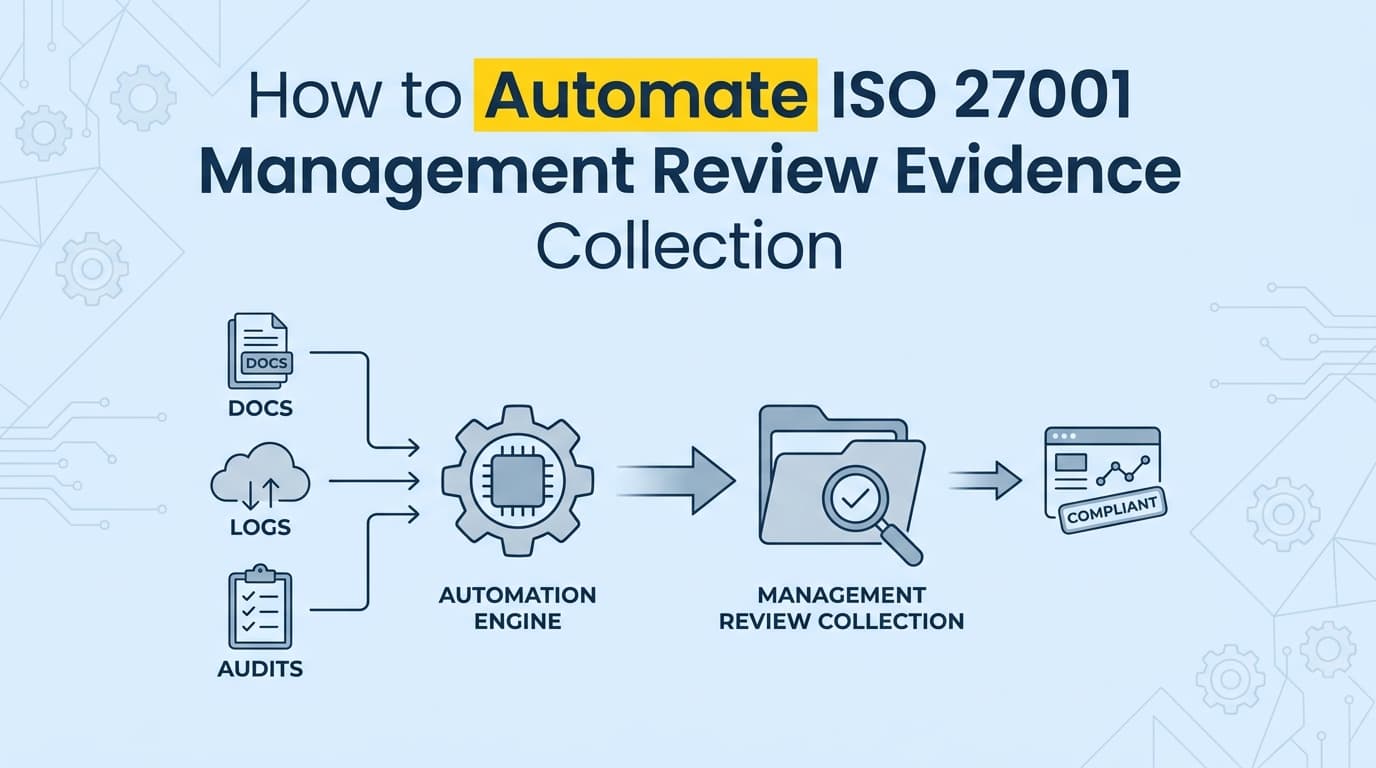
How to Automate ISO 27001 Management Review Evidence Collection
ISO 27001 certification requires more than just configuring technical controls in your cloud environment. You have to prove your leadership team actually governs the Information Security Management System (ISMS). This means providing evidence for Clause 9.3 (Management Review) and Clause 10 (Continual Improvement). While you can pull technical metrics automatically, capturing the actual documentation for these administrative requirements, like meeting minutes, nonconformity tracking, and corrective action workflows, often requires manual screenshots and exports. Automating this evidence collection ensures your leadership activities are audit-ready without creating massive administrative overhead.
What Evidence Do ISO 27001 Auditors Actually Check for Clause 9.3?
Auditors look for specific artifacts to prove that top management reviews the ISMS at planned intervals. They are checking that the meeting happened, that you discussed a mandatory list of inputs, and that leadership generated actionable outputs.
You need to provide documentation that covers these specific areas:
Proof of occurrence A calendar invite isn't enough on its own, but it establishes the timeline. You need the calendar record showing who was invited and who actually attended. If your CEO is required to be there but didn't attend, the auditor will flag it.
The presentation or agenda (The Inputs) Clause 9.3 explicitly lists what you must discuss. Your evidence needs to show that you reviewed:
- Status of actions from previous management reviews
- Changes in external and internal issues relevant to the ISMS
- Feedback on information security performance (including nonconformities, monitoring results, and audit results)
- Feedback from interested parties
- Results of risk assessments and status of the risk treatment plan
- Opportunities for continual improvement
Meeting minutes and decisions (The Outputs) This is where most companies fail. Auditors want to see what decisions were made. Your documentation must show leadership's decisions regarding continual improvement opportunities and any needed changes to the ISMS. If the meeting minutes just say "Reviewed risks, everything is fine," an auditor will dig deeper. They want to see resource allocations, budget approvals, or specific directives.
How Do You Document Continual Improvement (Clause 10)?
Clause 10 requires you to react to nonconformities and take action to control, correct, and deal with the consequences. You then have to evaluate the need for action to eliminate the root causes so the issue doesn't happen again.
Auditors expect to see a documented workflow. In practice, this usually lives in a ticketing system like Jira, Linear, or Asana.
The evidence you need to capture includes:
- The initial ticket logging the nonconformity or incident.
- The root cause analysis (RCA) discussion.
- The corrective action plan.
- Proof that the corrective action was implemented.
- A follow-up review showing that the corrective action actually worked.
Auditors prefer visual evidence of this lifecycle. A screenshot of a Jira epic showing the progression from "Reported" to "Root Cause Identified" to "Fix Deployed" to "Verified" is exactly what they want to see.
What ISO 27001 Evidence Cannot Be Automated with GRC Tools
Where traditional ISO 27001 automation stops is at the boundary of human processes.
GRC platforms are excellent at connecting to AWS via API to verify that encryption at rest is enabled (satisfying Annex A.8.24). They fall completely flat when it comes to Clause 9.3 and Clause 10.
An API cannot attend your management review. A compliance dashboard cannot automatically parse a Confluence page to verify that your CEO approved a budget increase for a new endpoint detection tool. GRC tools track the status of your compliance, but they leave the actual collection of administrative and workflow evidence to you.
This forces practitioners to spend hours manually taking screenshots of Jira boards, exporting PDF meeting minutes from Notion, and organizing Slack threads where leadership approved risk treatment plans.
How to Automate Evidence Collection for ISMS Governance
You can automate the collection of management review and continual improvement evidence by deploying tools that capture workflows rather than just reading APIs.
Here is how you handle the administrative evidence burden:
Automating ticket lifecycle capture
Instead of manually hunting down Jira tickets that represent your corrective actions, you can use workflow recorders to automatically capture the state of specific issue tags (e.g., iso-corrective-action). The system takes screenshots of the ticket details, the comment thread showing the root cause analysis, and the resolution status, then packages it into a timestamped PDF.
Capturing approval chains If your management review outputs result in a Slack or Teams thread where a VP approves a new security initiative, that thread is audit evidence. Automated evidence tools can capture these specific conversations, apply cryptographic timestamps to prove when the approval happened, and map them directly to Clause 9.3 in your evidence library.
Documenting the ISMS metrics dashboard During your management review, you likely look at a dashboard showing system uptime, vulnerability patching SLAs, or phishing simulation results. You can schedule an AI agent to automatically navigate to these dashboards on the day of your management review, capture the visual state of the metrics you discussed, and file them as the official inputs for that quarter's meeting.
Auditors do not need your management reviews to be a bureaucratic nightmare. They just need a clear, verifiable paper trail that leadership is paying attention and taking action. Automating the capture of this documentation lets your management team focus on actual security decisions rather than formatting evidence packs.
Learn More About ISO 27001 Evidence Automation
For a complete look at how to handle both the administrative clauses and the technical Annex A controls, see our guide on automating ISO 27001 evidence collection, including how to replace manual screenshot gathering with continuous, audit-ready workflows.
Connect and see
See your SOC 2 with your real systems.
Connect GitHub and cloud read-only. Vera shows your control matrix, policy gaps, and prioritized next actions before you commit to anything.