

Compliance
How to Reduce SOC 2 Compliance Costs with Automated Evidence Collection
Manual evidence collection is the hidden driver of high SOC 2 costs. By using automated tools to capture screenshots and generate audit-ready reports, companies can cut a SOC 2 Type II year from about 200 hours of team time to 60-80. This article explains the ROI of evidence automation.
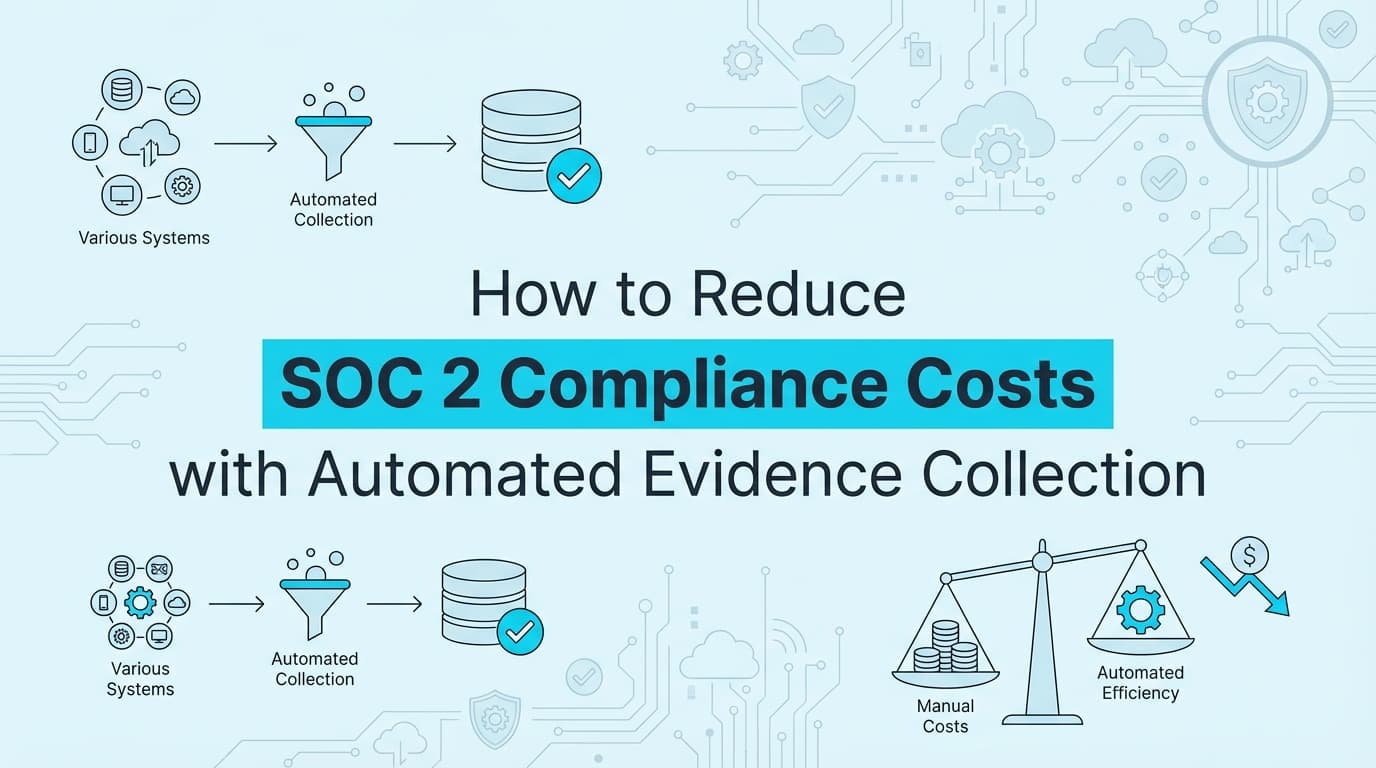
Reducing SOC 2 compliance costs requires automating the manual collection of evidence, specifically screenshots and application workflow documentation. While infrastructure monitoring is often automated, high-growth companies still spend thousands of dollars in engineering time manually capturing SOC 2 evidence for application controls. Screenata solves this by using automation to capture screenshots, validate workflows, and generate audit-ready reports, eliminating the manual overhead that inflates audit fees and operational costs.
Why Are SOC 2 Compliance Costs So High for Growth Companies?
For high-growth companies, the cost of SOC 2 is not just the auditor's fee, it is the opportunity cost of engineering and product teams distracted by compliance tasks.
While GRC platforms like Drata and Vanta automate approximately 80% of evidence collection (infrastructure, device management, and HR data), the remaining 20% of application-level controls remains manual. This "manual gap" forces highly paid engineers to stop building product and start taking screenshots.
The Hidden Costs of Manual Evidence
- Engineering Drag: A SOC 2 Type II year run on a GRC platform takes about 200 hours of your team's time, much of it manual evidence collection. At $150/hr, that is about $30,000 in lost productivity.
- Audit Overage Fees: Manual screenshots are often rejected for missing timestamps or context, leading to "re-testing" fees from auditors.
- Delayed Sales Cycles: If an audit is delayed because evidence is missing, enterprise deals requiring SOC 2 reports are stalled, directly impacting revenue.
How Does Automated Evidence Collection Reduce Audit Costs?
Automating evidence collection replaces expensive human labor with AI-driven workflow recording. Instead of an engineer manually logging into a system, navigating to a settings page, taking a screenshot, and pasting it into a Word doc, Screenata records the interaction and generates the artifact automatically.
Cost Reduction Breakdown
| Cost Driver | Manual Process | Automated with Screenata | Savings |
|---|---|---|---|
| Evidence Collection | 60 mins/control (Engineer) | 5 mins/control (AI Agent) | 92% Time Savings |
| Documentation | Manual formatting in Word | Auto-generated PDF Pack | 100% Automated |
| Rework / Re-testing | High (Human Error) | Near Zero (Standardized) | Eliminated Fees |
| Audit Duration | 4–6 Weeks | 1–2 Weeks | Faster Time-to-Report |
Where Traditional SOC 2 Automation Stops
To understand where the cost savings come from, it is necessary to distinguish between Infrastructure Automation (what Drata/Vanta do) and Evidence Automation (what Screenata does).
Most companies believe buying a GRC tool solves the entire cost problem. However, GRC tools rely on APIs. If a control cannot be verified via an API (e.g., "Prove that the 'Delete User' button triggers a confirmation modal"), the GRC tool marks it as "Manual" and assigns it to a human.
The "Manual Gap" That Drives Costs
- GRC Tool (Drata/Vanta): Checks if AWS CloudTrail is on. (Automated ✅)
- GRC Tool (Drata/Vanta): Checks if employees accepted policies. (Automated ✅)
- Manual Reality: Prove that Role-Based Access Control (RBAC) prevents a "Viewer" from accessing the "Billing" page. (Manual ❌)
Screenata fills this specific gap. By automating the visual and functional verification of these application controls, it removes the last significant source of manual labor in the audit process.
How Screenata Automates Evidence for Cost Reduction
Screenata reduces costs by turning manual "click-and-capture" tasks into repeatable, automated workflows.
1. Automated Workflow Recording
An engineer performs the test once (e.g., demonstrating the User Provisioning flow). Screenata records the session, capturing DOM elements, network requests, and screenshots automatically.
2. Intelligent Metadata & Context
The system automatically appends necessary audit data, timestamps, user IDs, and browser versions, eliminating the risk of auditors rejecting evidence for "lack of context." This prevents costly back-and-forth cycles with the auditor.
3. Direct Integration with GRC Platforms
The generated Evidence Pack (a structured PDF) is automatically uploaded to the relevant control in Drata or Vanta. This eliminates the administrative overhead of file management and uploading.
ROI Example: High-Growth SaaS Company
Consider a Series B SaaS company with 150 employees undergoing a SOC 2 Type II audit.
Without Screenata (Manual Application Testing):
- Controls requiring screenshots: 25 controls (quarterly).
- Time per control: 1 hour (collection + formatting + upload).
- Total Engineering Time: 100 hours/year.
- Cost (Eng Rate $150/hr): $15,000 / year.
- Audit Management Overhead: 40 hours ($6,000).
- Total Operational Cost: $21,000.
With Screenata (Automated):
- Time per control: 5 minutes.
- Total Engineering Time: ~8 hours/year.
- Cost: $1,200 / year.
- Audit Management Overhead: 5 hours ($750).
- Total Operational Cost: $1,950.
Net Savings: $19,050 per year (plus the intangible value of faster audit completion).
Example: Automating Costly Controls (CC6.1 & CC7.2)
Two of the most expensive controls to document manually are Logical Access (CC6.1) and Change Management (CC7.2).
Control CC6.1: Logical Access
- Manual Cost: An engineer must log in as different user roles, try to access restricted areas, take screenshots of error messages, and document the matrix.
- Automated Solution: Screenata runs a script that logs in as "Viewer," attempts to hit
/admin, captures the "403 Forbidden" screen, and generates a pass/fail report.
Control CC7.2: Change Management
- Manual Cost: For every sampled change, an engineer must find the Jira ticket, the GitHub PR, and the deployment log, screenshot them, and stitch them into a PDF.
- Automated Solution: Screenata integrates with the CI/CD pipeline to automatically generate a "Change Evidence Pack" for every deployment, linking the PR approval screenshot to the deployment timestamp.
Do Auditors Accept Automated Cost-Saving Evidence?
Yes. Auditors prefer automated evidence because it is more reliable and less prone to tampering than manual screenshots.
Screenata generates evidence that aligns with AICPA standards for reliability:
- Completeness: The PDF includes the full workflow, not just a cropped image.
- Accuracy: Timestamps are synced to NTP servers, not the user's system clock.
- Authenticity: A cryptographic hash ensures the evidence hasn't been altered since capture.
By providing higher-quality evidence, companies reduce the time auditors spend reviewing files, which can negotiate down the variable hourly fees charged by audit firms.
Frequently Asked Questions
How much can Screenata reduce my SOC 2 audit costs?
For a SOC 2 Type II year, our cost model puts your team's time at 60-80 hours with Screenata against about 200 hours DIY on a GRC platform. At $150/hr that saves $18,000-$21,000 in internal time, and organized evidence can also mean fewer auditor follow-ups.
Does Screenata replace Drata or Vanta?
For most startups, yes. Screenata is an AI compliance officer + platform that handles everything--evidence collection (infrastructure + application), policy writing from your codebase, control mapping, and audit prep. It replaces both the compliance platform and the consultant ($5K-$20K for Type I readiness) you would need alongside Drata or Vanta. For a Type I, first-year cash with Screenata is $11K-$16K including the auditor, or $12K-$19K with your team's time, against $28K-$61K with a traditional platform plus consultant. Those figures are year one, under 50 employees, Security criteria, your team's time at $150/hr. Model your own numbers with the SOC 2 cost calculator. If you already have Drata or Vanta, Screenata can also work alongside it to fill the application evidence gap. See The Bootstrapped Founder's Guide to SOC 2 for the full cost breakdown.
Can automated evidence help with ISO 27001 costs too?
Yes. The same evidence collected for SOC 2 (e.g., access control, change management) can be mapped to ISO 27001 Annex A controls. Screenata allows you to "collect once, satisfy many," drastically reducing the cost of multi-framework audits.
Is it worth automating if we only audit once a year?
Yes. "Audit fatigue" is a major hidden cost. Even for annual audits, the context switching required for engineers to relearn manual evidence procedures is expensive. Automation ensures the process is repeatable and instant, regardless of frequency.
Key Takeaways
- ✅ Manual evidence is the cost driver: 20% of controls cause 80% of the manual labor costs in SOC 2. And the consultant you need to write policies and prep the audit costs $5-20K for Type I readiness, and up to $120K across a Type II year.
- ✅ Time is money: Automating screenshots saves ~100 engineering hours per year for a mid-sized company.
- ✅ Eliminate re-work: Automated evidence packs prevent auditor rejection and costly re-testing cycles.
- ✅ Speed to revenue: Faster audits mean faster sales cycles for enterprise deals.
- ✅ Screenata replaces both the platform and the consultant: Type I first-year cost of $12K-$19K with team time (including the auditor) vs $28K-$61K with a traditional platform plus consultant.
Learn More About SOC 2 Automation
- The Bootstrapped Founder's Guide to SOC 2 -- full cost breakdown and what to expect
- Do You Actually Need a vCISO for SOC 2? -- why most startups do not need a consultant anymore
- Why ChatGPT SOC 2 Policies Fail Audits -- what auditors actually want in your policies
- How to Automate SOC 2 Evidence Collection -- comprehensive SOC 2 automation guide
Connect and see
See your SOC 2 with your real systems.
Connect GitHub and cloud read-only. Vera shows your control matrix, policy gaps, and prioritized next actions before you commit to anything.