

Compliance
Do You Actually Need a vCISO for SOC 2? (Probably Not Anymore)
For most B2B SaaS companies, no. AI compliance tools now handle scoping, policy writing, evidence collection, and audit prep end-to-end. This guide breaks down which SOC 2 tasks are fully automated and the few scenarios where a human consultant still matters.
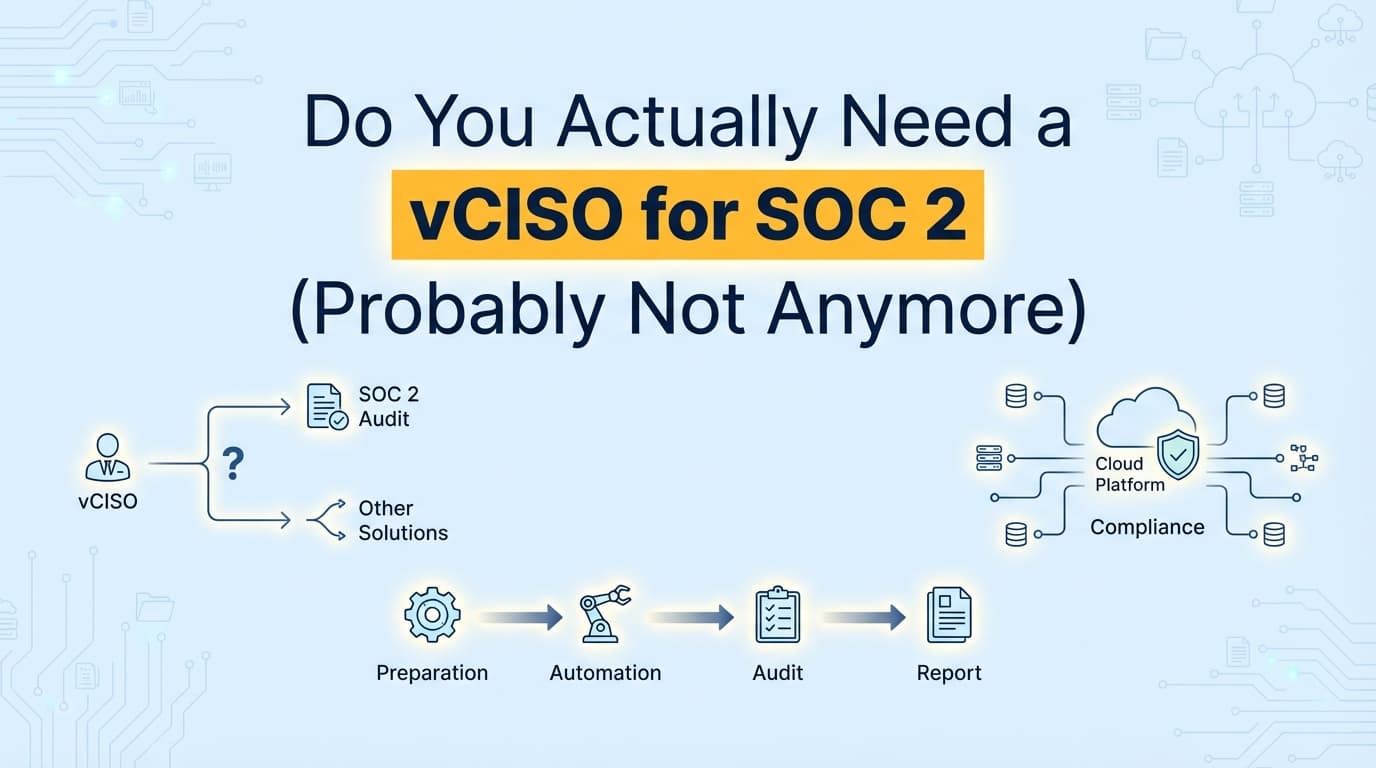
For a standard B2B SaaS company pursuing SOC 2 Type I or Type II, you do not need a retained vCISO. Five years ago, hiring a consultant was the only way to decipher the AICPA's Trust Services Criteria, draft policies, and gather documentation. Today, AI compliance tools handle the entire workflow: scoping, policy writing, evidence collection, control mapping, and audit prep.
What Does a vCISO Actually Do for SOC 2?
To figure out whether you can skip the consultant, look at what they actually bill for. A typical vCISO engagement involves seven tasks:
- Scoping: Deciding which Trust Services Criteria (Security, Availability, Confidentiality, etc.) apply to your product.
- Policy Writing: Drafting information security policies (Access Control, Risk Management, Incident Response, etc.).
- Gap Analysis: Comparing your current operations against SOC 2 requirements.
- Evidence Planning: Defining what screenshots, logs, and configurations prove compliance.
- Remediation Guidance: Telling you to turn on MFA, encrypt databases, set up background checks.
- Auditor Liaison: Translating auditor requests into language your engineering team understands.
- Readiness Assessment: A "dry run" audit to catch failures before the real auditor arrives.
Five years ago, a consultant doing these seven things was genuinely valuable. Today, all seven are handled by AI compliance tools. The last two used to be the hardest to automate, but AI assistants can now answer compliance questions in context and provide continuous readiness scoring against Trust Services Criteria.
Which SOC 2 Tasks Can AI Handle vs. Which Need a Human?
Here is where each task stands today:
| SOC 2 Task | Traditional vCISO | AI Compliance Officer (Screenata) |
|---|---|---|
| Scoping | 2-hour workshop to determine applicable criteria | 5-minute conversational wizard based on your product and customers |
| Policy Writing | Find-and-replace company name in Word templates | AI reads your codebase and cloud, writes policies grounded in your real systems |
| Gap Analysis | Consultant reviews your setup over 2-3 sessions | Automated scan of GitHub, AWS/GCP, IdP identifies gaps against TSC |
| Evidence Collection | Asks you to take screenshots and upload to a folder | Automatically pulls evidence from your systems: user lists, MFA configs, branch protection, encryption settings |
| Remediation Guidance | Consultant tells you what to fix in a weekly call | Readiness dashboard with prioritized actions and an AI assistant that answers questions |
| Auditor Liaison | Translates auditor requests (still valuable for complex cases) | AI assistant answers compliance questions; human support available for edge cases |
| Readiness Assessment | One-time dry run before audit | Continuous readiness scoring that updates as you make changes |
For a standard B2B SaaS company with modern infrastructure (AWS/GCP, GitHub, Google Workspace or Okta, Slack), every row in this table is handled by software. The "human judgment" exceptions that vCISOs cite are real, but they apply to a small minority of companies. More on that below.
The Cost Math: vCISO + Platform vs. AI Compliance Officer
The financial case is clear.
Traditional Path:
With Screenata:
The auditor line is identical on both paths. The difference is the consultant and the hours. The traditional path has you paying for a compliance platform that gives you a dashboard and a checklist, then paying a consultant on top to actually fill out the checklist. Screenata does both jobs.
For a detailed breakdown of where every dollar goes, see The Bootstrapped Founder's Guide to SOC 2.
When Should You Actually Hire a vCISO?
There are specific scenarios where AI hits a wall and a human expert earns their fee. If you fall into these categories, do not try to do this yourself.
1. You Have Complex Regulatory Overlap
If you handle patient data (HIPAA + HITRUST) or sell to the federal government (FedRAMP / CMMC), the overlap between frameworks gets messy. A control that satisfies SOC 2 CC6.1 might fail a specific CMMC requirement. Software is getting better at cross-framework mapping, but the legal liability of getting it wrong is high. A consultant helps navigate the gray areas.
2. You Are a Large Enterprise with Legacy Infrastructure
AI compliance tools work best with modern cloud APIs (AWS, Okta, GitHub). If your environment includes on-premise servers, mainframes, or custom legacy ERPs that don't expose APIs, automated tools will show gaps. A vCISO is necessary to design manual control frameworks for infrastructure that software can't reach.
3. Your Board or Contracts Require a Named CISO
Some enterprise contracts or board mandates strictly require a named Chief Information Security Officer. A fractional CISO checks this box. If a breach occurs, having an external expert who signed off on your security program can provide defensibility that software alone cannot.
When a vCISO Is Overkill
For a standard B2B SaaS company with fewer than 50 employees, a modern tech stack, and a SOC 2 Security TSC audit, none of the above scenarios apply. You are paying consultant rates for someone to log into a platform and click buttons you could click yourself. Or worse, you are paying them to write policies from the same Word templates every other startup gets.
Why Compliance Platforms Alone Are Not Enough Either
- Write their policies. You get templates with blank fields. Someone still has to fill them in with claims that match your actual systems.
- Tell them what to put in the policies. A compliance platform does not know that your app uses Clerk for authentication or that your CI/CD pipeline runs on GitHub Actions. It monitors infrastructure, but it does not read your codebase.
- Answer compliance questions. When you are staring at a Trust Services Criteria requirement and wondering what it means for your specific product, a dashboard cannot help.
- Guide them through remediation. The platform flags that you are missing a control. It does not tell you exactly what to do about it.
Screenata does both. It reads your codebase and cloud infrastructure, writes policies grounded in your real systems, collects evidence automatically, and tells you what to fix. See what compliance platforms miss and what Screenata does differently.
Conclusion: You Need an Expert, Not an Expense
If your budget is tight and your tech stack is modern, you do not need a vCISO and you do not need a separate compliance platform. Screenata is the platform and the compliance officer. Save the consulting budget for a high-quality audit firm that can give you a clean report.
For teams pursuing SOC 2 for the first time, start with SOC 2 for First-Timers: What to Read, What to Skip, and What to Tell Your CEO. For a full cost breakdown, see The Bootstrapped Founder's Guide to SOC 2. And if you are wondering whether AI-generated policies actually pass audits, read Why ChatGPT SOC 2 Policies Fail Audits, it explains why generic AI output fails but codebase-grounded policies work.
Connect and see
See your SOC 2 with your real systems.
Connect GitHub and cloud read-only. Vera shows your control matrix, policy gaps, and prioritized next actions before you commit to anything.